
What Is a Sales Funnel? A Simple Guide for Small Business Owners
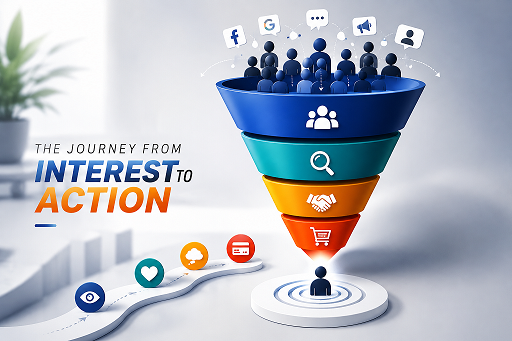
A sales funnel is the step by step journey a person goes through, from the moment they first hear about your business to the moment they become a paying customer.
It is called a funnel because you start with a wide group of people who are simply aware of you, and that group naturally narrows down at each stage until only the ones who are truly ready to buy remain.
If you have ever wondered why some people visit your page and leave, while others come back and buy, the answer usually has nothing to do with luck.
It has to do with whether your business has a clear funnel guiding that person from curiosity to confidence.
Why Every Business Already Has a Funnel, Whether They Planned It or Not
Even if you have never designed one on purpose, your business already has a funnel. Someone hears about you, checks you out, thinks about it, and either buys or disappears.
The real question is not whether you have a funnel. It is whether that funnel is working for you or quietly losing you customers at every stage.
A planned, intentional funnel simply takes that natural process and removes the friction, confusion, and drop off points that cause people to lose interest before they ever reach the point of paying you.
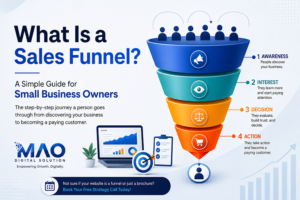
The Four Basic Stages of a Sales Funnel
1. Awareness
This is the top of the funnel, where someone first learns your business exists. This could happen through a Google search, a social media post, a referral from a friend, or an advert. At this stage, the person does not know you yet, and they are not ready to buy. They are simply becoming aware that a solution to their problem exists.
2. Interest
Once someone is aware of you, they start paying closer attention. They might follow your page, read a blog post, or check your website to understand what you actually offer. At this stage, your job is to educate and build trust, not to sell aggressively.
3. Decision
This is where the person is actively comparing you to other options, or weighing whether to commit at all. They are asking questions like, is this worth the price, can I trust this business, and will this actually solve my problem. This is usually where testimonials, case studies, guarantees, and clear pricing matter most.
4. Action
This is the final stage, where the person makes a purchase, books a call, or signs up. A good funnel makes this step as simple and low friction as possible, because even a small amount of confusion at this stage can cause someone to abandon the process entirely, even after everything else went right.
A Simple Example
- Imagine someone finds your business through a Google search for a service you offer. That is awareness.
- They read a helpful blog post you wrote about that exact problem, and they start to see you as knowledgeable. That is interest.
- They visit your pricing page and read a few reviews from past clients. That is decision.
- Finally, they click a button to book a free call with you. That is action.
Nothing about this feels forced, because a well built funnel does not feel like a sales pitch. It feels like a natural, helpful path that answers someone’s questions in the right order.
Why a Sales Funnel Matters More Than Just a Website
A regular website often shows everything at once, with no clear order and no clear next step. A sales funnel, on the other hand, guides the visitor one step at a time toward a specific action. This is usually the biggest reason two businesses can have similar traffic numbers, yet one converts far more visitors into paying customers than the other.
If you want to understand this difference in more detail, we broke it down fully in our guide comparing a sales funnel website to a regular website.
How MAO Digital Solution Helps With This
We help businesses build sales funnels that match how their actual customers think and buy, instead of copying a generic template. This includes the website structure, the messaging at each stage, and the follow up systems that keep potential customers moving forward instead of forgetting about you.
If you are not sure whether your current website is functioning as a funnel or just an online brochure, we would be happy to take a look and walk you through it on a free call.
Book Your Free Strategy Call
Frequently Asked Questions
What is the difference between a sales funnel and a marketing funnel?
The terms are often used interchangeably, but a marketing funnel typically focuses on the earlier stages of awareness and interest, while a sales funnel extends further to include the decision and action stages where an actual purchase happens.
Do small businesses really need a sales funnel?
Yes. Any business that sells something, whether online or in person, benefits from understanding the path a customer takes before buying. A clear funnel simply makes that path easier to guide and improve on purpose.
How do I know if my sales funnel is not working?
Common signs include getting traffic or inquiries that do not turn into sales, people asking the same basic questions your website should already answer, and visitors leaving without taking any next step at all. These usually point to a gap at a specific stage of the funnel.